Miami Herald Latest Local News
- 3.9
- Rating
- 50.00K
- Installs
- Free
- Price

 Analysis by App-foxy
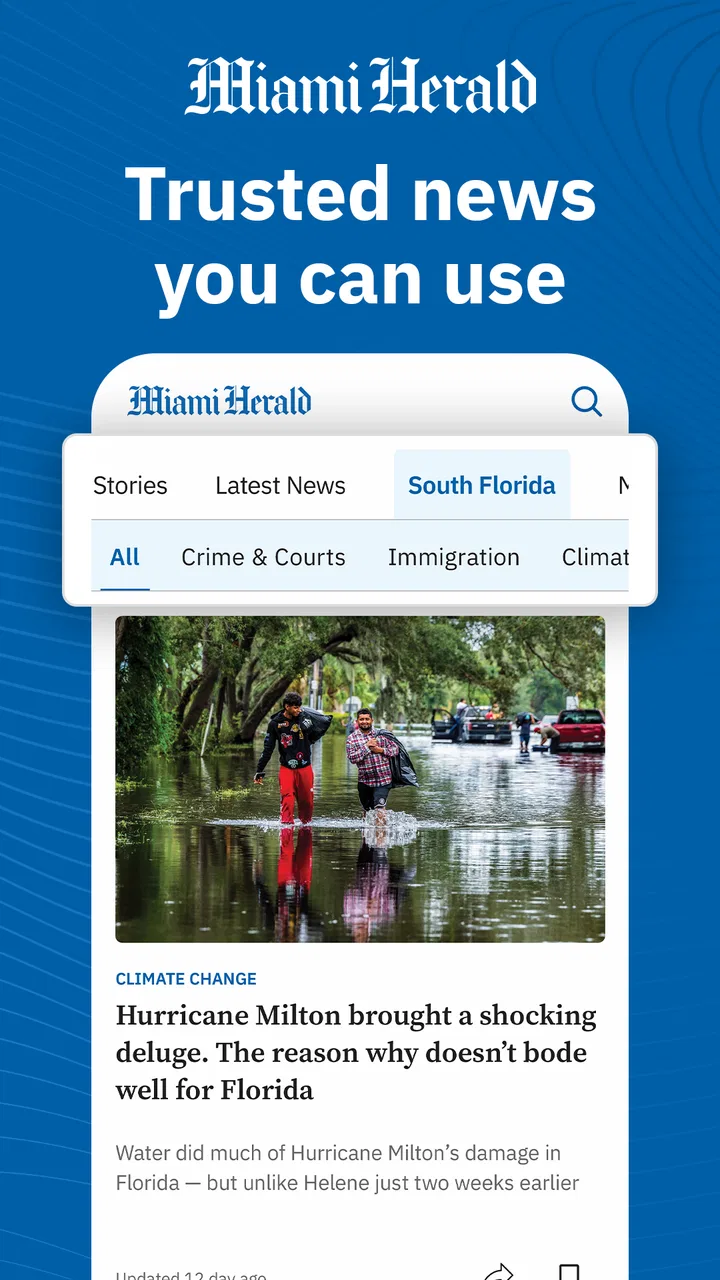
When I want a quick sense of what is happening across South Florida, I find that Miami Herald Latest Local News makes more sense than opening a general national news app and searching for Miami every time. This free news and magazine app comes from McClatchy and focuses its attention on local reporting, including politics, business, crime, weather and sports. That narrow focus is its main reason to install it: it is built for readers who want regional context rather than an endless stream of unrelated headlines.
My first impression is that this is best treated as a local news companion, not as a complete replacement for every source on a phone. It can help me catch up during breakfast, check the local situation before leaving home, or follow an issue that affects Miami-area residents. At the same time, the experience may feel less useful if I mainly want international coverage, a large collection of lifestyle stories, or a completely free reading experience without any account or subscription-related prompts.
The app is free to download and is rated for Everyone 10+, which makes it approachable for a broad household audience. Its average rating sits at 3.9 from around 800 ratings, while the app has passed 50 thousand installs. Those figures suggest a reasonably established product, though not one I would describe as universally loved. I would install it because of the local emphasis, then judge it by whether that coverage matches the neighborhoods and subjects I actually follow.
You May Also Like

 Pandora - Music & Podcasts
Pandora’s Music Is Easy to Start, but Harder to Recover
Pandora’s strength is its low-effort path from a seed to a station. Its weak spot is how much confidence it asks you to place in connection, setup, and quiet recovery.

 8 Ball Pool
 Is Built on Rivalries, Rematches, and Routine
A close look at the rivalries, rematches, shared routines, and unanswered safety questions that turn a quick pool match into a persistent mobile community.

 Samsung Music
’s Quiet Strength Is Playing What You Already Own
Its reach comes less from spectacle than from dependable access to a personal library. That simplicity is both the app’s strongest retention engine and its ceiling.

 AccuWeather: Weather Radar
AccuWeather Review: A Quick, Clear Forecast for Everyday Decisions
For everyday plans, the best forecast is the one you can understand quickly. AccuWeather makes rain timing, radar, and local conditions easy to act on, with a few trade-offs.

 Hill Climb Racing
Why Hill Climb Racing Still Turns Crashes Into One More Run
A tiny car, a bumpy hill and one more upgrade: Hill Climb Racing keeps resurfacing because its simple chaos makes every near-miss feel personal.

 AliExpress - Shopping App
AliExpress Makes Global Shopping Feel Personal, but Shoppers Bear the Risk
AliExpress turns a global marketplace into a pocket-sized discovery engine. Its reach is useful, its shopping loop compelling, and its trade-offs easy to miss.
More From Our News Desk
View All News


What to expect from the local news experience
The most useful way to understand this app is to picture it as a front door to Miami Herald coverage on a mobile device. Instead of beginning with a broad national feed, I begin with stories connected to Florida and the Miami area. That changes how I use it. I am not opening the app to fill every spare minute with random articles; I am opening it to answer practical questions such as what local officials are doing, whether a major incident is developing, what businesses are changing, or how weather may affect the day.
That local concentration is valuable because regional stories often disappear beneath larger national headlines in general-purpose apps. A nationwide news reader may tell me that a storm exists, for example, but a local publication is more likely to make the story relevant to roads, neighborhoods, public services and nearby communities. I still would not rely on any single app for urgent safety decisions, but this is a sensible place to begin a local-information routine.
The coverage areas also make it easier to decide whether the app belongs on your phone. Politics readers can use it to follow Florida and Miami-area government developments. Business readers may appreciate a regional view of companies and economic activity. Crime coverage can help residents understand incidents in the area, although I recommend reading beyond a headline before drawing conclusions. Sports followers get a local angle, while weather coverage gives the app an obvious everyday use.
One trade-off is that a focused local publication will not behave like a social feed. You may not find the same breadth of commentary, viral material or international reporting available in larger news aggregators. I consider that a strength when I want less noise, but a weakness when I want one app to cover the entire world. If your reading habit is mostly national or global, a broader news service will probably be a better primary choice.
The developer is McClatchy, and the app has been available since May 24, 2012. Its current version is 11.1.16 and it supports devices running Android 8.0 or later. That long presence matters in a small but practical way: I approach it as an established publication app rather than a brand-new experiment. Still, an older release history does not guarantee that every screen will feel modern, so I pay more attention to clarity and reading comfort than to flashy presentation.
Installing it without overthinking the decision
Because the download is free, the initial decision is fairly low risk. I would install it on a phone that runs Android 8.0 or newer, open it when I have a few quiet minutes, and avoid judging it solely by the first headline screen. News apps often become more useful after I understand how their sections are arranged and how they present access to individual stories.
There are in-app purchases ranging from $1.99 to $159.99 per item. I take that as a reason to read each purchase screen carefully rather than assuming that every article or feature is included in the free experience. The free installation lets me explore the app, but the path from browsing to paid access may matter if I intend to use it as my daily newspaper. Before confirming anything, I would check exactly what the prompt offers, whether it is a recurring commitment, and which content it unlocks.
This is also where expectations help. Installing a newspaper app is not the same as subscribing to a newspaper, and seeing a story preview does not necessarily mean that unlimited reading is available without conditions. I prefer to spend the first session learning what can be read immediately. That prevents the common mistake of treating the download price as the total cost of long-term use.
Setting up a useful first session
On the first launch, I would take a calm, deliberate route rather than tapping through every screen automatically. First, I would scan the main feed and identify whether the mix reflects my interests. Then I would open one story from a practical category such as weather, local politics or business. Finally, I would return to the main screen and see whether the app makes it easy to move between different kinds of local coverage.
This simple routine answers an important question: does the app help me reach information, or does it mainly show me a promotional doorway? A good first session should leave me knowing where to look for the topics I care about. If the page feels crowded, I would slow down and distinguish editorial headlines from account or purchase prompts. That small separation makes the rest of the experience less confusing.
I would also decide what role the app should have on my phone. For me, the most realistic role is a morning check-in and an occasional source for developing local stories. Someone who needs minute-by-minute emergency alerts may need a dedicated official alert system as well. Someone who only reads sports may prefer a specialist sports app. Miami Herald Latest Local News is strongest when I want several local subjects gathered under one publication rather than one narrow beat.
A useful, less obvious habit is to read one substantial article instead of judging the publication by a headline list. Headlines tell me what the app wants me to notice, but an opened story reveals whether the writing gives enough background for a newcomer. This matters especially for local politics and crime, where a short headline can leave out the history needed to understand what happened. I would use the first article as a test of context, not just speed.
Reaching the first meaningful result
My definition of success with this app is not simply completing the installation. It is finding one local story that changes what I know about my day. That could be a weather update that affects a commute, a city decision relevant to a neighborhood, a business development connected to work, or a sports report I can discuss with friends. To reach that point, I would pick the section closest to my immediate need instead of scrolling aimlessly through every headline.
For a first-time user, I recommend starting with a question. “What should I know about Miami this morning?” is broad but useful. “Is there local weather information that affects my plans?” is more specific. “What is changing in Florida politics?” creates a clear reading goal. Once I find an article that answers part of the question, I can decide whether the app deserves a place in my daily routine.
There is a practical advantage to this question-led approach: it exposes the difference between a local publication and a generic aggregator. An aggregator may produce more links, but I often have to sort through duplicated reports and unrelated commentary. A focused publication can feel calmer because the editorial selection is already narrowed to the region. The cost is that I have fewer perspectives in one screen, so for major or controversial subjects I would still compare the report with another reputable source.
Another useful workflow is to separate discovery from verification. I use the app to discover what local issue deserves attention, then I read the full article and check the date and context before sharing it. This is especially important for crime stories, where an early report can evolve. The app is valuable as a starting point, but responsible reading means resisting the urge to treat the first headline as the complete story.
Weather is an especially practical entry point because it connects the app to a real decision. Before heading out, I can use the local focus to see whether weather is part of the day’s news picture, then use a dedicated weather service if I need precise, current conditions. That division of labor is sensible: the Miami Herald app gives me local editorial context, while a specialist tool may be better for detailed forecasts or alerts.
Where new users may get confused
The biggest potential confusion is the difference between a free app and free unlimited reading. The download costs nothing, but in-app purchases are present, with individual items priced from $1.99 up to $159.99. I would not assume that a purchase is necessary before exploring, and I would not confirm one until I understand whether it is a one-time item or a longer access arrangement. This is the point where careful reading is more useful than fast tapping.
A second source of confusion is the relationship between the app name and the publication. The app is not a general Miami utility with maps, public-service forms and local directories. It is a news and magazines product. If I install it expecting a complete city guide, I will probably be disappointed. Its job is to present reporting, not to replace every local service on my phone.
Readers may also wonder whether the app is suitable for children. The Everyone 10+ rating means I would treat it as family-accessible with some age awareness, not as a children’s news product. Crime and political coverage can involve subjects that younger readers may need help interpreting. For a household device, I would use my own judgment about which stories are appropriate and discuss sensitive coverage rather than assuming the rating describes the tone of every article.
Another point worth understanding is the rating itself. A 3.9 average from around 800 ratings gives me a useful but limited signal. It tells me that the experience has attracted both satisfied and dissatisfied users, but it does not explain whether a complaint concerns performance, access, article selection or a particular device. I would use the app personally before making a strong judgment, especially because local relevance varies widely from one reader to another.
Finally, I would not confuse a local focus with complete neighborhood-level coverage. Miami and Florida contain many communities and interests, and an article that matters to one reader may not appear prominently for another. If I live outside the core coverage area or mainly want hyperlocal information about a small municipality, a community publication or local government channel may serve me better. This app is more compelling when my interests align with the wider Miami-area news agenda.
Turning it into a routine that does not waste time
Once I know what the app offers, I would keep the routine simple. I might open it once in the morning, scan the major local subjects, read one story fully, and return later only when a developing issue matters to me. That prevents the app from becoming another endless-scroll habit. The value of a local news app comes from informed attention, not from spending every spare minute refreshing a feed.
I would also vary the section I read. Checking only crime headlines can create a distorted view of the city, while reading only sports leaves out the civic information that may affect daily life. Alternating between politics, business, weather and sports gives me a more balanced sense of the region. This is a small but meaningful advantage of having several local beats in one publication app.
For people who commute, the app can fit naturally into a before-work routine: review local headlines, open the weather-related report if relevant, and save deeper reading for a quieter moment. For residents following a local policy debate, it can act as a running source of background, provided they read full articles and compare important claims. For former Miami residents, it may be a convenient way to keep up with the area without subscribing to a broad national paper solely for local stories.
There are also clear reasons to skip it. I would look elsewhere if I wanted a completely ad-free, subscription-free reading experience, a highly personalized algorithmic feed, or extensive international coverage. I would also choose another tool for emergency alerts, exact weather measurements, or official legal and public-service information. The app can inform those decisions, but it should not be mistaken for the authoritative system behind them.
Compared with a general news aggregator, the Miami Herald app offers stronger regional identity and less need to search for Florida stories manually. Compared with a social media feed, it should provide a more deliberate editorial starting point and less dependence on whatever happens to be trending. Compared with a specialist weather or sports app, it is broader but less purpose-built. Those comparisons explain its place on my phone: it is a local newspaper window, not an all-purpose information dashboard.
My final recommendation is cautiously positive for readers who genuinely want Miami-area reporting. I like the clear local purpose, the mix of civic and practical subjects, and the ability to begin with a meaningful question instead of sorting through a national flood of headlines. I would install it for the regional perspective, use the first session to test article depth, and treat any purchase prompt as something to inspect carefully.
The best first step is simple: open one local story, read it all the way through, and decide whether it helps you understand something that matters today. If it does, the app can become a useful part of a morning news habit. If the coverage feels too narrow, the access terms do not suit your budget, or you need specialized alerts and tools, keeping a broader or more specialized alternative nearby will make more sense. In my view, that honest division of roles is the way to get the most from Miami Herald Latest Local News without expecting it to be something it was not designed to be.
FAQs for Miami Herald Latest Local News
01What is the Miami Herald Latest Local News app used for?
The Miami Herald app is designed to keep readers informed about breaking news and local developments in Miami-Dade, Broward, and South Florida. It typically includes reporting on politics, crime, education, business, sports, weather, entertainment, and community issues. The app also provides access to selected national and international stories published by the Miami Herald.
02Is the Miami Herald app free to download and use?
Downloading the Miami Herald app is generally free on supported Android and iOS devices, but access to all articles may require a subscription or an active digital membership. Some stories may be available without signing in, while premium content, unlimited reading, newsletters, and other benefits can be restricted to subscribers. Pricing and trial options may vary by region and promotion.
03Do I need a subscription to read every article?
A subscription may be necessary to read the full Miami Herald archive and access articles after reaching any available free-reading limit. The exact restrictions can change over time, so users should review the subscription information shown in the app or on the official website. Existing subscribers can usually sign in to connect their digital access with the mobile application.
04Does the app support breaking news alerts and personalized content?
The Miami Herald app may offer push notifications for breaking news, major local events, weather updates, sports results, and other important developments. During setup, users can often choose which alerts they want to receive and adjust them later through the app or device settings. Notification availability and personalization options can depend on the current app version.
05Can I use the Miami Herald app without an internet connection?
Most news content requires an internet connection to load the latest articles, images, videos, and updates. Depending on the version and subscription features, some content may be saved or made available for limited offline reading, but users should not assume that every article can be accessed offline. For the best experience, connect to reliable Wi-Fi or mobile data before browsing.
Pros
- Covers breaking news and local events across Miami-Dade and South Florida.
- Offers a mix of politics
- weather
- business
- sports
- and community reporting.
- Push alerts can help readers stay informed about important local developments.
- Articles are generally easy to browse by topic and location.
- Useful for following Miami-area issues that national news apps may overlook.
Cons
- Some articles or features may require a paid subscription to access fully.
- Frequent notifications can feel excessive unless alert settings are customized.
- Coverage may focus heavily on Miami-Dade compared with nearby Florida communities.
- App performance and loading speed may vary with connection quality.
- Advertising and subscription prompts can interrupt the reading experience.

Miami Herald Latest Local News
Gallery